The real economics of owning a farming drone in the UK
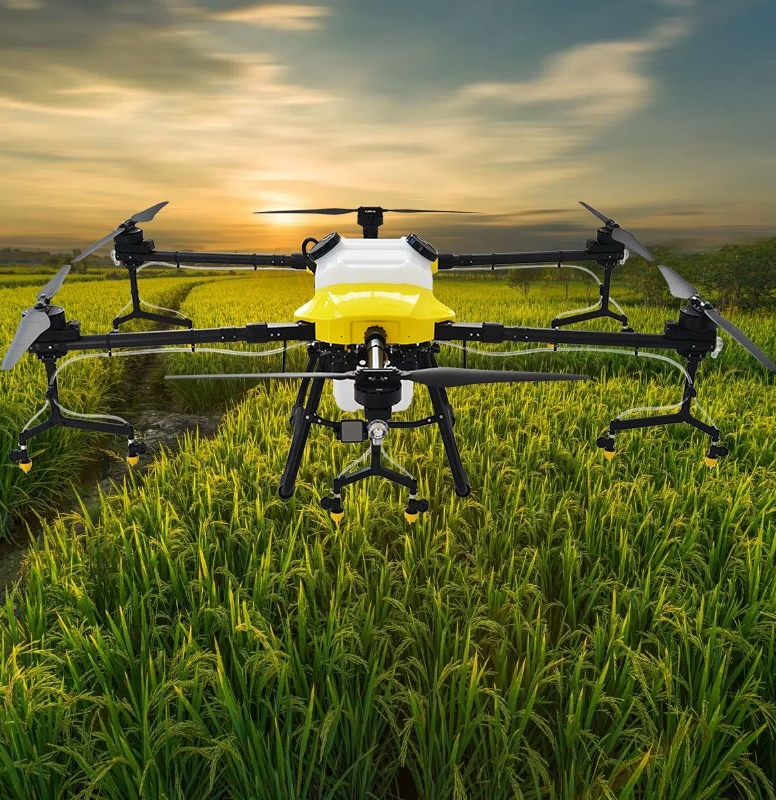
As drone technology becomes more visible across UK agriculture, a practical question is emerging on farms of all sizes: should we invest in our own equipment, or access it through a service provider?
At first glance, ownership appears attractive. Having a drone on-site offers flexibility, immediate availability, and the potential to reduce reliance on external contractors. For larger farms, the idea of integrating drone operations directly into existing workflows is particularly appealing.
But the economics are more nuanced
Owning a drone is not simply a capital purchase. It introduces a set of ongoing requirements: training, certification, maintenance, insurance, and operational planning.
In the UK, compliance with regulations governed by the Civil Aviation Authority adds an additional layer of complexity. For many farmers, these factors represent a hidden cost—both in time and money.
Utilisation is the critical variable.
To justify ownership, a drone must be used frequently enough to spread its cost over a sufficient number of hectares. For farms with limited acreage, or those requiring drone services only at specific points in the season, achieving this level of utilisation can be challenging. In such cases, the cost per hectare may exceed that of hiring a specialist provider.
Service-based models, by contrast, offer access without commitment. Contractors bring not only equipment, but expertise—often delivering higher efficiency and consistency, particularly in the early stages of adoption. For many farms, this provides a lower-risk entry point into precision agriculture.
However, ownership becomes more compelling as scale increases.
Larger operations, or those managing multiple sites, can achieve higher utilisation rates, improving the economics significantly. There is also a strategic benefit: the ability to deploy drones immediately in response to changing conditions, without waiting for contractor availability. In time-sensitive scenarios, this responsiveness can translate directly into yield protection.
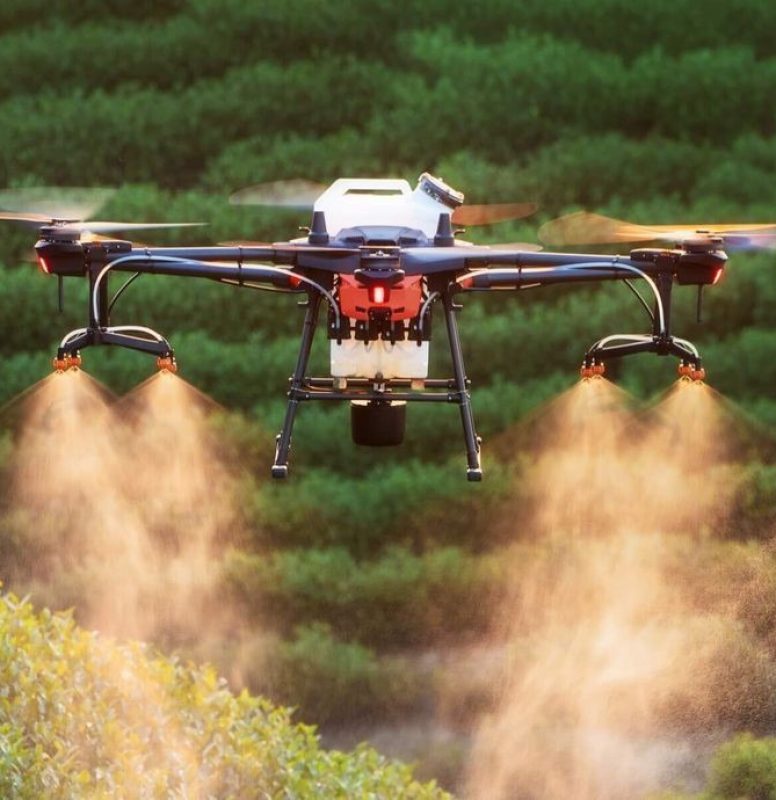
A hybrid model is increasingly common. Farms begin by using contractors to understand the value and practicalities of drone operations. As confidence grows—and as use cases expand from mapping to spraying and beyond—some transition to partial or full ownership.
The decision, ultimately, is less about technology and more about operational fit.
How often will the drone be used? How critical is immediate access? Does the farm have the capacity to manage compliance and maintenance? And perhaps most importantly: where does drone capability sit within the broader strategy of the business?
There is no universal answer. But there is a clear trend.
As the benefits of drone technology become more tangible, the question is shifting from whether to adopt, to how to integrate it most effectively. For some, that will mean ownership. For others, partnership.
In both cases, the objective remains the same: to deploy technology in a way that enhances productivity, reduces cost, and strengthens resilience in an increasingly complex agricultural landscape.
The real economics of owning a farming drone in the UK
As drone technology becomes more visible across UK agriculture, a practical question is moving from curiosity to urgency: should we invest in our own drone capability, or access it through a service provider?
It’s a deceptively simple choice. In reality, it is a strategic decision that shapes cost structure, operational flexibility, and the pace at which a farm can adopt precision agriculture.
The appeal of ownership
At first glance, ownership feels like the logical end state. A drone on-site offers immediacy. When conditions are right or when they are about to turn you can act without delay. In a sector defined by narrow weather windows, that responsiveness has real value.
There is also a sense of control. Drone operations can be integrated into existing workflows, aligned with agronomic decisions, and deployed exactly when needed. For larger arable farms in particular, this can feel like a natural extension of existing machinery ownership.
But this perspective often captures only part of the equation.
The hidden cost base
Owning a drone is not simply a capital purchase; it is the creation of a new operational capability.
Beyond the upfront investment, farms must account for:
In the UK, compliance with rules set by the Civil Aviation Authority introduces an additional layer of responsibility. Airspace awareness, operational permissions, and safety procedures all require attention, and time.These are not insurmountable barriers, but they are frequently underestimated. And when they are, the true cost per hectare rises accordingly.
The utilisation threshold
The single most important variable in this decision is utilisation.
A drone generates value only when it is in use. To justify ownership, it must be deployed frequently enough to spread its total cost across a meaningful number of hectares. For farms with limited acreage, or those requiring drone services only at specific moments, such as targeted spraying or occasional mapping, this threshold can be difficult to reach.
In these cases, the economics can quickly favour a service model. Paying per hectare or per job converts a fixed cost into a variable one, aligning expenditure directly with need.
The case for contractors
Service providers offer more than access to equipment. They bring experience, efficiency, and established workflows.
For farms at an early stage of adoption, this matters. The learning curve associated with drone operations particularly spraying, can be steep. Contractors, by contrast, operate at scale, often delivering faster setup times, more consistent application, and fewer operational errors. There is also a risk dimension. By outsourcing, farms avoid the burden of compliance, maintenance, and technical troubleshooting. This allows them to focus on outcomes rather than execution.
Perhaps most importantly, contractors provide a way to test value before committing capital. Farms can evaluate real-world impact on cost, yield, and efficiency without taking on the full risk of ownership.
The real economics of owning a farming drone in the UK
When ownership starts to make sense
The equation shifts as scale and complexity increase. Larger farms, or those managing multiple sites, are more likely to achieve the utilisation required to justify ownership. Frequent use across mapping, spraying, and monitoring reduces cost per hectare and strengthens the business case.
There is also a strategic advantage in immediacy. When timing is critical, waiting for contractor availability can introduce delays. In fast-moving scenarios disease outbreaks, weather-driven interventions having in-house capability can protect yield in ways that are difficult to quantify, but highly material.
Over time, as drone operations become embedded within the farm’s decision-making processes, ownership can transition from a cost to a capability
The rise of the hybrid model
Increasingly, UK farms are not choosing one model over the other they are combining both.
A typical pathway begins with contractors, allowing farms to understand the practical applications and economic benefits of drone technology. As confidence grows, some invest in their own equipment for specific use cases, while continuing to use external providers for others.
This hybrid approach balances flexibility with control. It reduces risk while enabling gradual capability building.
A strategic, not technical, decision
It is tempting to frame this as a technology choice. It is not. The decision to buy or hire is fundamentally about how a farm chooses to operate. It reflects priorities around capital allocation, labour, risk tolerance, and responsiveness.
Key questions include:
There is no universal answer. A 200-hectare mixed farm and a 2,000-hectare arable enterprise will arrive at different conclusions and both may be right.
From experimentation to integration
What is clear is that the conversation is evolving. For many UK farmers, drones are no longer an experiment. They are becoming part of the operational toolkit alongside machinery, agronomy, and data systems. As that shift continues, the question will move beyond whether to adopt, to how best to integrate.
For some, ownership will unlock speed and control. For others, partnerships will deliver efficiency and flexibility.
Either way, the objective remains unchanged: to deploy technology in a way that improves margins, strengthens resilience, and enables better decisions in an increasingly complex farming environment.