How Drones Are Reducing Chemical Use Without Sacrificing Yield

How Drones Are Reducing Chemical Use Without Sacrificing Yield

Producing more with less:
How drones are reducing chemical use without sacrificing yield

Few challenges in modern agriculture are as complex or as scrutinised as the use of chemicals. Farmers are under increasing pressure to reduce inputs, driven by regulation, environmental concerns, and shifting public expectations. At the same time, the need to protect crop yields remains unchanged.

This creates a fundamental tension

How to use less, without producing less.

Drone technology is beginning to resolve that tension, not by eliminating inputs, but by
applying them with far greater precision.

Traditional spraying methods are designed for scale. Large boom sprayers cover entire
fields efficiently, but they do so uniformly. Every hectare receives the same treatment,
regardless of variation in crop condition, soil type, or disease pressure. Inevitably, this
leads to over-application in some areas and under-application in others.

Drones invert this model.

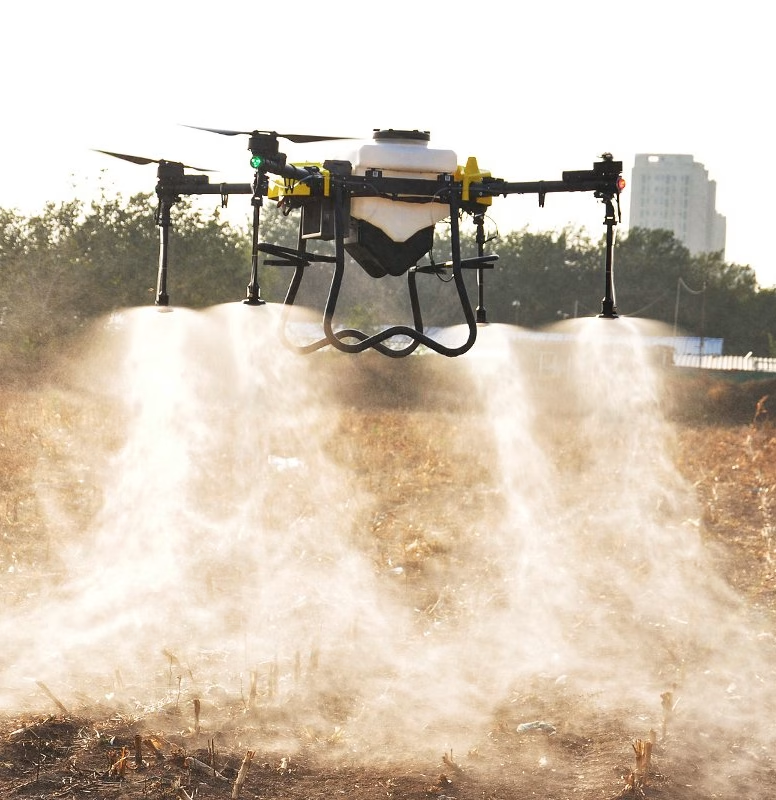
By combining high-resolution mapping with targeted application, inputs can be directed only where they are needed. Areas showing early signs of stress or disease can be treated precisely, while healthy zones are left untouched. The result is a reduction in total chemical use, without compromising protection where it matters most.

This approach also improves efficacy. Targeted spraying reduces drift, improves coverage, and allows applications to be timed more accurately. Instead of waiting for conditions suitable for large machinery, farmers can respond quickly to emerging issues, often within narrower and more optimal windows

The environmental implications are significant. Reduced runoff, lower chemical loads, and more efficient use of inputs all contribute to improved sustainability outcomes.

For farms participating in environmental schemes, this alignment is increasingly important, not just for compliance, but for securing financial incentives.

However, the most compelling argument remains economic.

Inputs represent one of the largest variable costs in arable farming. Even modest reductions, when applied across large areas, translate into meaningful savings. When combined with maintained or improved yields, the impact on margin can be substantial. Critically, this is not a theoretical benefit. Farms adopting precision spraying are already reporting lower input costs alongside more consistent crop performance. The gains may not always be dramatic in a single season, but they compound over time.

There is also a reputational dimension. As supply chains place greater emphasis on sustainability, the ability to demonstrate reduced chemical usage without yield penalty becomes a competitive advantage. The narrative around inputs is changing. It is no longer about how much is applied, but how intelligently it is used. In that shift, drones are not just a tool for efficiency, they are a mechanism for redefining what “optimal” looks like in modern UK agriculture.

Shopping Cart

No products in the cart.