How variable rate drone spraying Is transforming farm economics
Agriculture is entering one of the most significant periods of operational transformation in its history. Rising input costs, labour shortages, climate volatility, tightening environmental regulation, and increasing pressure from supply chains to demonstrate sustainability are forcing farms to rethink how resources are deployed across every hectare.
For decades, crop spraying followed a relatively simple principle: apply fertilizers, fungicides, herbicides, and crop protection products uniformly across entire fields. While operationally efficient at scale, this approach assumed that fields behaved as homogeneous systems. In reality, every experienced farmer understands the opposite is true. Soil conditions vary metre by metre. Moisture retention changes across landscapes. Pest pressure develops unevenly. Nutrient deficiencies emerge in isolated zones. Disease outbreaks rarely spread uniformly.
Drone-based Variable Rate Spraying (VRS) is emerging as one of the most important precision agriculture technologies because it directly addresses this mismatch between uniform treatment and highly variable field conditions.
By combining drones with multispectral imaging, AI-driven analytics, GPS-guided application systems, and real-time crop intelligence, farming businesses can move away from blanket application strategies toward highly targeted interventions. Increasingly, this is not simply about adopting new technology. It is about building a more efficient, resilient, and economically competitive farming model.
Precision application creates immediate efficiency gains
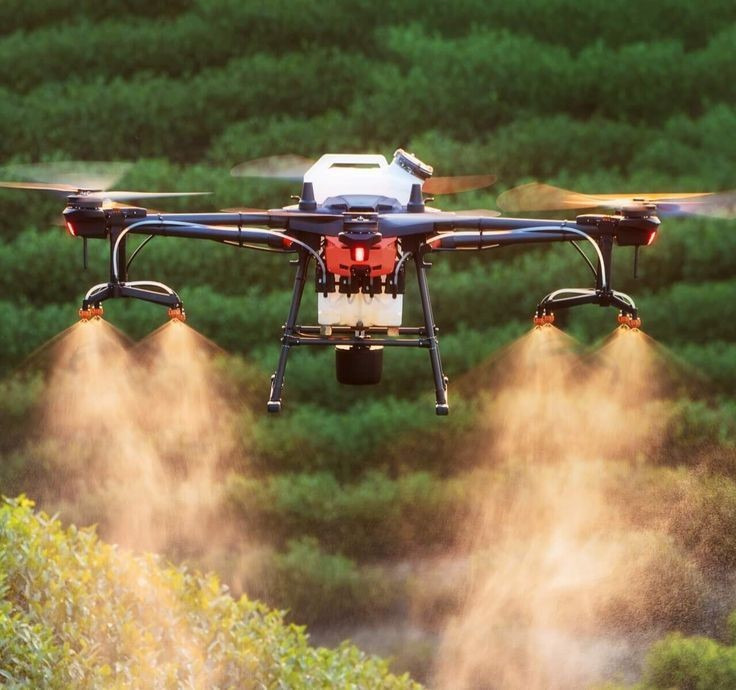
The core principle behind Variable Rate Spraying is straightforward: apply the right amount of product, in the right place, at the right time. Traditional spraying systems distribute fixed volumes of fertilisers, fungicides, herbicides, or pesticides across entire fields regardless of local variation. Drone-based systems instead allow application rates to change dynamically according to crop conditions identified through aerial mapping and data analysis.
Using multispectral and thermal imaging, drones can identify areas experiencing nutrient stress, disease
development, weed infestation, water stress, or uneven biomass growth. Spraying algorithms can then adjust application intensity based on the actual condition of specific field zones rather than field-wide averages. This creates measurable operational efficiencies.
Research into precision spraying technologies consistently demonstrates that targeted application can substantially reduce chemical usage while maintaining effective crop protection and productivity outcomes. Studies show that drone-based precision spraying systems can reduce pesticide usage by between 30% and 50% through targeted application rather than blanket field treatment. AI-enabled variable-rate systems have also demonstrated reductions in chemical waste of up to 47% by identifying disease hotspots and concentrating treatment only where required.
The impact on weed management is particularly significant. Research into site-specific herbicide application has shown herbicide savings ranging from 11% to 78%, depending on crop type, weed density, and field variability. In corn production systems, UAV-based spot spraying has reduced herbicide costs by approximately 46% compared with conventional broadcast spraying approaches.
Drone-based systems also improve water efficiency. Precision application methods can reduce water usage during spraying operations by approximately 40–50%, lowering both operational costs and environmental impact.
The economic implications are considerable. Crop protection products and fertilisers remain among the largest operational expenditures on most arable farms. Even relatively modest reductions in unnecessary application can materially improve profitability across large acreages.
More importantly, precision application fundamentally changes the economics of crop
management. Instead of increasing productivity primarily through greater input intensity, farms can increasingly improve margins through smarter deployment of existing resources.
In an era where agricultural competitiveness is increasingly defined by efficiency rather than expansion alone, this shift matters strategically.
Faster intervention reduces agronomic risk
Agricultural productivity is frequently determined by timing. A fungal outbreak identified early may require only localised treatment. The same outbreak left untreated for several days during favourable weather conditions can rapidly escalate into a field-wide problem. Nutrient deficiencies, weed emergence, and pest infestations follow similar patterns.
Drone spraying significantly improves operational responsiveness. Unlike conventional machinery, drones can deploy rapidly with minimal setup requirements and without dependence on ground conditions. This becomes particularly important during narrow treatment windows where delayed access can materially affect crop outcomes. Wet weather illustrates the advantage clearly. Heavy ground sprayers often struggle to access fields after rainfall without creating soil damage, rutting, or compaction.
Drones eliminate this constraint entirely because they operate aerially rather than through direct field traffic. The operational implications are substantial. Farms gain the ability to treat localised issues immediately rather than waiting for conditions suitable for larger machinery. This shift from delayed reactive management toward rapid precision intervention can help contain disease spread, protect crop quality, and reduce yield losses.
Recent research examining autonomous precision spraying systems has highlighted how AI-enabled
drones can localise disease intensity and optimise spray routes to maximise treatment effectiveness while minimising wasted inputs. This directly contributes to improved crop performance. Variable-rate drone spraying has been associated with yield improvements of approximately 12–20%, depending on crop type, disease pressure, and environmental conditions. `
In practical farming terms, speed increasingly equals resilience.
Reduced soil compaction protects long-term productivity
One of the less discussed, but highly important, advantages of drone spraying is the
elimination of wheel traffic damage. Modern agricultural machinery is extraordinarily productive, but repeated field passes inevitably contribute to soil compaction. Compacted soils reduce root penetration, impair drainage, decrease oxygen availability, and weaken water infiltration capacity. Over time, this can materially suppress productivity and increase vulnerability to drought conditions.
Drone-based spraying removes this compromise entirely. Because aerial systems never contact the soil surface, they allow farmers to conduct crop treatments without physically disturbing the field. This becomes particularly valuable in high value crops, waterlogged fields, and regenerative farming systems focused on preserving soil structure and long-term soil health.
Drone systems also enable treatment in areas often difficult or impossible for traditional
machinery to access effectively, including wet fields, steep terrain, high-canopy crops, and
compaction-sensitive soils. The importance of soil preservation is increasing as climate variability intensifies. Healthy soils provide greater resilience against both drought and heavy rainfall by improving water retention, drainage, and nutrient cycling simultaneously.
In this context, drone spraying should not be viewed solely as an efficiency technology. It is increasingly part of a broader strategy focused on soil stewardship, sustainability, and longterm land productivity.
Sustainability pressures are accelerating adoption
Agriculture faces mounting pressure to reduce environmental impact while simultaneously increasing
productivity. Governments, retailers, investors, and consumers are demanding greater transparency
around chemical use, water management, biodiversity protection, and carbon reduction.
Drone-based Variable Rate Spraying aligns naturally with these emerging priorities. Because inputs are applied only where needed, precision spraying reduces chemical overuse, minimises runoff risk, and lowers unnecessary environmental exposure. Targeted application can also significantly reduce spray drift into surrounding habitats and watercourses. Research suggests drone precision spraying can reduce pesticide drift by approximately 60% compared with conventional spraying methods, representing a major environmental advantage in sensitive
agricultural areas.
This is particularly important in the UK, where environmental land management frameworks and sustainability-linked incentives are increasingly tied to measurable evidence of responsible resource use. Equally important is the data layer generated by drone operations.
Modern agricultural drones produce detailed digital records including geospatial spray maps, crop health
analytics, application histories, and operational reporting. These records can support compliance requirements, sustainability audits, assurance schemes, and future carbon-accounting frameworks.
Over time, data transparency itself may become commercially valuable. Food retailers and agricultural supply chains are already demanding greater visibility into farming practices. Farms capable of demonstrating precise, measurable, and environmentally responsible input management may gain competitive advantages in procurement relationships, financing access, and longterm supply partnerships.
Labour constraints are reshaping farm operations
Labour shortages continue to challenge agricultural operations across the UK. Skilled machinery operators are increasingly difficult to recruit, while seasonal pressures create growing operational bottlenecks.
Drone systems help address part of this challenge through automation and operational efficiency. A single trained drone operator can survey fields, generate analytical maps, and deploy precision spraying operations with significantly reduced infrastructure requirements compared with traditional systems. Autonomous route planning and AI assisted analytics further reduce operational complexity.
Research into autonomous spraying platforms suggests that drone-based systems can reduce labour costs by approximately 40–60% through automation and reduced machinery dependency. Importantly, this does not eliminate the need for agronomic expertise. In many respects, precision agriculture increases the value of informed decision-making because better data enables more sophisticated crop management strategies.
However, it does shift labour away from repetitive mechanical activity toward analytical oversight and strategic farm management. This transition reflects a broader evolution occurring across agriculture, where technology increasingly augments human expertise rather than simply replacing physical labour.
The economics are becoming increasingly compelling
Historically, precision agriculture technologies were often viewed as expensive innovations accessible primarily to large-scale operations. That perception is beginning to change rapidly. Drone hardware costs have fallen considerably in recent years while software capabilities have improved dramatically. At the same time, rising fertiliser, fuel, and chemical prices are strengthening the return-on investment case for precision application systems. As input costs continue to fluctuate, technologies that improve efficiency become increasingly attractive economically.
Research examining UAV-based spot spraying systems suggests that many farms are now approaching economic break-even with conventional spraying operations as chemical savings and operational efficiencies improve.
In addition, drone systems support multiple operational functions beyond spraying alone. The same platforms may be used for crop scouting, multispectral crop analysis, drainage assessment, biomass mapping, environmental monitoring, and livestock management. This multi-functionality improves overall equipment utilisation and strengthens the commercial case for adoption.
The future farm will be data-driven
Drone-based Variable Rate Spraying represents part of a much broader transformation underway across global agriculture. The future farm is likely to operate as an interconnected digital ecosystem where drones, autonomous machinery, sensors, satellite systems, weather platforms, and AI-driven
analytics continuously exchange information to optimise decision-making in real time. Emerging research already demonstrates how AI-enhanced drone systems can identify disease hotspots, optimise spray paths, and dynamically adjust treatment intensity according to changing crop conditions during flight.
Over time, these systems will become increasingly autonomous, predictive, and
interconnected. For forward-looking farming businesses, the strategic importance of drone spraying extends beyond the technology itself. It represents an early step toward a fundamentally different
agricultural operating model one built around precision, intelligence, sustainability, and
adaptability.
The farms that embrace these capabilities earliest are likely to gain advantages not only in efficiency and profitability, but also in resilience as agricultural conditions become more volatile, resource constrained, and environmentally regulated.
Drone-based Variable Rate Spraying is therefore not simply a new method of applying chemicals. It is part of the broader evolution of agriculture from uniform industrial processes toward intelligent, responsive, and data-driven farming systems. FarmingByDrone is the UK’s leading providers of agricultural drones and drone-based contract farming services. Talk to us today about how we can help you achieve better insights, stronger yields, and more consistent returns.